Psychological biases that even pro traders struggle with
The daily foreign exchange market activities surpass trillions of US dollars based on central bank statistics while the market includes both individual traders and major financial organizations. The core of trading operations depends on human decision-making even though trading systems now use advanced analytics and algorithmic execution and structured risk models. Financial media platforms show behavioral research which proves that cognitive biases affect both financial experts with experience and new investors. Experience helps people avoid particular mistakes but it does not stop them from making emotional decisions based on their reactions to market gains and losses and market fluctuations and unknown events.
The institutional perspective on behavioral finance in trading
Financial institutions that are large in size operate under established risk management systems but their employees still show behavioral weaknesses which become apparent at this organizational scale. Major financial media outlets show how portfolio managers change their investment exposure based on decisions made by the Federal Reserve and the European Central Bank and the Bank of Japan. The market volatility which occurs during these events creates difficulties for investors to stick to their discipline even though they have set particular position size rules.
The fund maintains two standard lots which invest in USD/JPY currency pair. The standard lot contains 100,000 currency units. If the pip value is approximately 9 to 10 USD per lot, a 40-pip move may result in roughly 800 USD change per lot, or 1,600 USD across two lots. The amount of required margin becomes smaller than the total exposure when leverage exists in the investment. The mathematical risk has a quantifiable value but market fluctuations in the short term create emotional responses which affect when to execute trades and how to set stop-loss levels.
The trading activities of institutional traders become less biased through their implementation of predefined margin limits and automated stop levels and post-trade analytics.
Overconfidence bias and the illusion of superior skill
Financial platforms show that investors tend to take more risks when their investments produce steady returns according to their performance data. People develop overconfidence bias through their practice of using their past successful predictions to demonstrate their forecasting abilities instead of understanding how market conditions supported their predictions. Traders who have experience with trading will sometimes expand their trading position sizes until they exceed their initial risk management strategy.
Let’s say a trader typically risks one mini lot, equal to 10,000 currency units, on EUR/USD. The 50-pip stop creates a risk exposure of 50 USD because the pip value equals 1 USD per pip. After several profitable trades, position size may increase to one standard lot, or 100,000 units, where the same 50-pip move now represents roughly 500 USD. The 1:30 leverage system creates a false impression that traders can handle their needed margin amounts which leads them to believe they have defense against market downturns.
Market conditions regarding liquidity and volatility tend to shift rapidly during times when macroeconomic data becomes available.
Confirmation bias in market analysis and research
The same data release receives different interpretations from Market coverage and economic commentary. The process of confirmation bias occurs when traders choose to view only evidence which supports their current market prediction while they dismiss all evidence which contradicts their prediction. The trading process of forex requires traders to make decisions about their position size and stop placement and leverage usage.
The Federal Reserve Economic Data platform reveals two conflicting economic indicators which show declining economic growth but continuing inflation rates. The trader will only accept bullish comments about EUR/USD because they already predict the currency pair will increase in value. A long position of one standard lot, equal to 100,000 units, may then be opened. The pip value amounts to 10 USD which means a 60-pip movement equals 600 USD. The trade benefits from a 1:30 leverage ratio because it maintains low margin requirements which are proportional to the total exposure amount thus providing traders with increased position security.
Investors will postpone their market exit decisions because they fail to evaluate opposing signals which appear in central bank statements. The combination of structured analysis with alternative scenarios and fixed risk percentages for each trade and objective economic calendar reviews minimizes the occurrence of selective interpretation. Investors can make investment decisions that are more balanced through the verification of macroeconomic data which uses price chart analysis.
Anchoring and its influence on entry and exit decisions
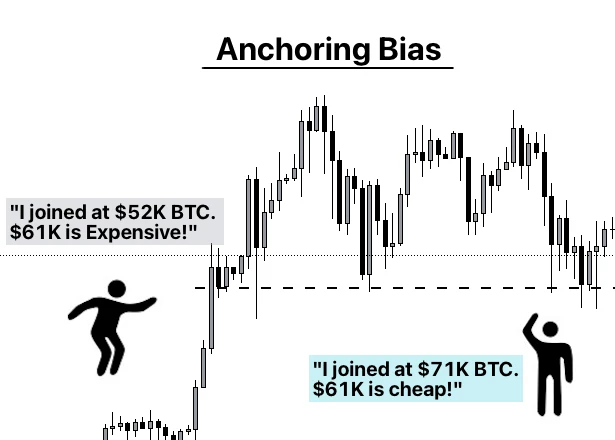
People tend to use price levels as mental benchmarks which they refer to. A trader develops anchoring when they choose to focus on one particular exchange rate or previous market high or entry price which they consider more important than the present market situation. The market draws investors through round numbers in currency pairs which include EUR/USD and USD/JPY because these numbers affect how investors predict market direction.
Let’s say a long position of one standard lot, equal to 100,000 currency units, was opened at 1.1000 in EUR/USD. With a pip value near 10 USD, a decline to 1.0950 represents about 500 USD unrealized loss. The first strategy used a 40-pip stop which traders needed to wait until prices reached beyond this point to execute their trade closures. The trading margin remains constant at 1:30 leverage but traders face increased risk when they increase the number of pips in their positions.
For example, anchoring can also affect profit targets. The practice of trading based on previous price levels for setting expectations leads to unfair market conditions between risk and reward. The evaluation of real-time price data together with volatility measures and stop distance definitions enables traders to make decisions based on facts. Structured trade plans eliminate the need to rely on random reference points.
Herd behavior and social proof in financial markets
Market coverage shows fast price changes when investors respond to news headlines and analyst rating changes and central bank statements. Market trends become the basis for traders to follow herd behavior because they abandon their independent risk evaluation process. The high liquidity of currency pairs leads to increased market volatility which expands rapidly throughout short periods of time.
The market will experience extensive USD purchasing activity when strong employment data becomes available. A trader observing rising momentum on a trading platform may enter one standard lot of USD/JPY, equal to 100,000 currency units. If the pip value is close to 9 USD per pip, a 35-pip move represents roughly 315 USD. The 1:30 leverage ratio leads investors to underestimate their potential losses because they view the needed margin as insignificant when compared to their complete investment value.
The market price will shift its direction when investors receive new market analysis which changes their investment expectations or when liquidity levels in the market decrease. A 50-pip market drop would result in a 450 USD loss for each trading lot. When trades are opened primarily because others are buying, stop placement and position size may not align with a structured plan.
Recency bias and the misinterpretation of short-term performance
Financial news cycles mainly distribute information about present economic statistics together with market price movements. People tend to value recent results more than information which extends across multiple time periods according to the phenomenon of recency bias. The short-term performance of forex trading requires traders to modify their lot size and leverage levels and stop distance settings.
Let’s say the last five trades on GBP/USD were profitable. A trader who normally risks 0.5 mini lots, equal to 5,000 currency units, may increase exposure to one standard lot, or 100,000 units. With a pip value near 10 USD, a 40-pip move now represents roughly 400 USD instead of about 20 USD on the smaller position. The 1:20 leverage ratio produces a false impression about margin requirements which might lead traders to increase their trading positions.
The presence of one dominant trend on a trading platform does not ensure that the market trend will continue. Central banks release broader macroeconomic data which shows that market trends make unexpected reversals according to historical volatility metrics. The evaluation of long-term win rates and average drawdown and risk-per-trade percentages shows that trading with fixed position sizes produces suitable market results.
Conclusion
The trading systems which operate in developed markets show psychological biases which affect their market trading behavior. The structured decision-making process reduces their ability to control decisions because it transforms all decision trade-offs into measurable data points. The total amount of exposure in a trade depends on lot size but the monetary effect of price changes depends on pip value and the required margin does not affect actual risk per pip.
The economic calendar together with central bank data and platform analytics serve as unbiased sources which help traders maintain their trading schedule. Traders can achieve consistent results through their scheduled performance reviews which utilize drawdown and expectancy metrics.
Additionally, they can maintain long-term stability through their use of established risk formulas for all trading activities and their implementation of rational market-based decisions.