Swing trading vs day trading Forex
Forex traders face a foundational choice early on — one that shapes not just their strategy but their daily routine, risk exposure, and psychological demands. Day trading and swing trading are the two dominant approaches, and the differences between them go well beyond how long a position is held.
Day traders open and close all positions within a single session. No overnight exposure, no waiting. Swing traders hold positions for days or sometimes weeks, targeting larger price moves and tolerating the uncertainty that comes with leaving trades open.
Both approaches can be profitable. Both carry real risk. And the better fit depends far more on a trader's circumstances than on which method sounds more appealing in theory.
The Forex market's structure makes it unusually well-suited to both styles. With roughly $7.5 trillion in average daily turnover according to the BIS, liquidity is rarely the limiting factor. What limits traders, more often than not, is a mismatch between their chosen method and the time, capital, and temperament they actually have.
How day trading works in forex
Day trading in Forex means entering and exiting all positions before the trading session closes — sometimes within minutes, sometimes within a few hours. The goal is to capture intraday price movements, which in a liquid market like EUR/USD can be substantial even if the daily range appears narrow on a percentage basis.
Execution is everything. Day traders rely on tight spreads, fast order fills, and platforms capable of handling rapid position changes. Most use one-minute to fifteen-minute charts, though the one-hour chart often serves as a reference frame for context.
Let's say EUR/USD moves 80 pips on a given day. A day trader isn't necessarily trying to capture all of it — more likely targeting a defined portion of a recognised intraday pattern, such as a breakout from the London open range or a reversion following a news-driven spike.
The approach demands near-constant attention during active hours. Positions left unwatched for even twenty minutes can reverse sharply on a data release. That reality is often underestimated by traders newer to the style.
How swing trading works in forex
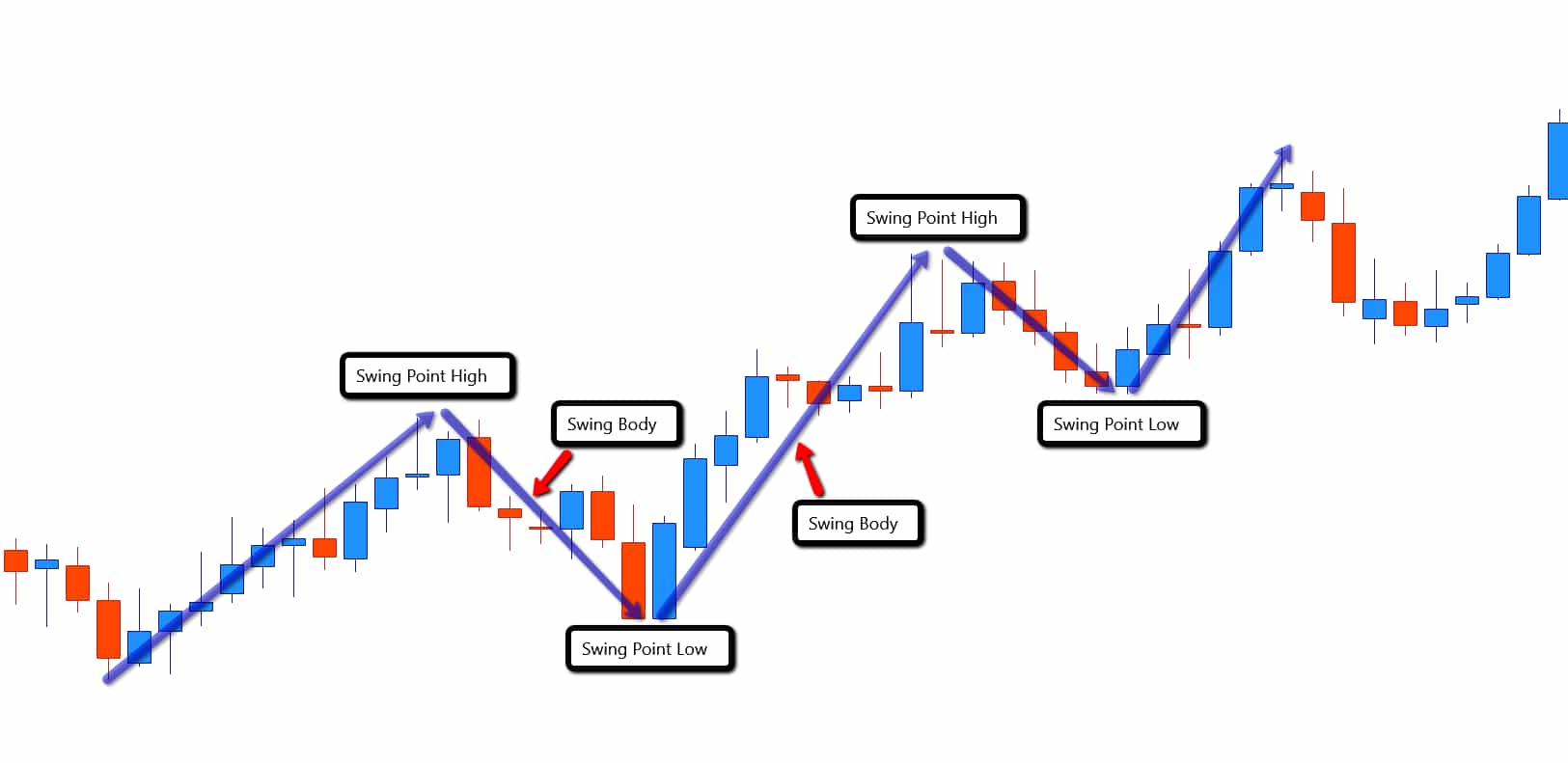
Swing trading operates on a different clock entirely. Positions are held across multiple sessions — often two to ten days — with the aim of capturing a directional move as it develops. The four-hour and daily charts do most of the analytical work.
The logic is straightforward: currency pairs trend. Not always cleanly, and not without interruption, but directional moves lasting several days occur regularly across major pairs. Swing traders attempt to enter near the beginning of such a move and exit before it exhausts itself.
Because entries and exits aren't time-pressured in the same way, analysis can be done outside market hours. A trader working a full-time job can review charts in the evening, place conditional orders, and check positions briefly during the day. That flexibility is a genuine structural advantage over day trading — not a compromise.
But holding overnight introduces risks day traders never face. Central bank announcements, geopolitical developments, and weekend gaps can all move a position significantly before the trader has a chance to react. Stop-loss placement becomes correspondingly more deliberate.
Time commitment and lifestyle fit
The time demands of each approach aren't just different in degree — they're different in kind. Day trading requires dedicated, uninterrupted screen time during active sessions. For traders based in time zones where the London or New York session falls outside business hours, that can mean early mornings or late nights sustained consistently. It's a schedule, not a hobby.
Swing trading's demands are less continuous but not less rigorous. The analytical work — identifying setups, determining position size, setting stops and targets — still requires genuine time and attention. What changes is the distribution. An hour of focused analysis before the market opens can be enough to manage an active swing position.
For traders who also hold other professional obligations, this distinction is often decisive. Attempting to day trade without the availability to monitor positions properly is one of the more reliable ways to accumulate losses. Swing trading doesn't eliminate that risk, but it does reduce the dependency on real-time presence.
Lifestyle fit is underweighted in most trading education. Choosing a style that conflicts with available time doesn't just create inconvenience — it creates structural disadvantage that no strategy can fully offset.
Risk exposure and capital requirements
Risk profiles differ substantially between the two styles, and the differences compound in ways traders sometimes fail to account for upfront.
Day traders face intraday volatility but sidestep overnight risk entirely. A position closed before the session ends can't be damaged by a gap open. That containment is real, but it comes at a cost — day traders typically use tighter stops to manage exposure within a session, which means individual trades can get stopped out by normal intraday noise rather than genuine trend reversals.
Swing traders carry overnight exposure on every open position. A surprise central bank statement after hours, or a geopolitical development over the weekend, can move price well past a stop-loss level before the trader has any opportunity to act. Slippage on gaps is a documented risk, not a theoretical one.
Capital requirements also diverge. Day traders using leverage to amplify small intraday moves often need more active margin management. Swing traders, working with wider stops, may size positions more conservatively to keep risk per trade within acceptable bounds.
Strategy and technical approach
The technical toolkit shifts considerably between the two styles, even when the underlying instruments are identical.
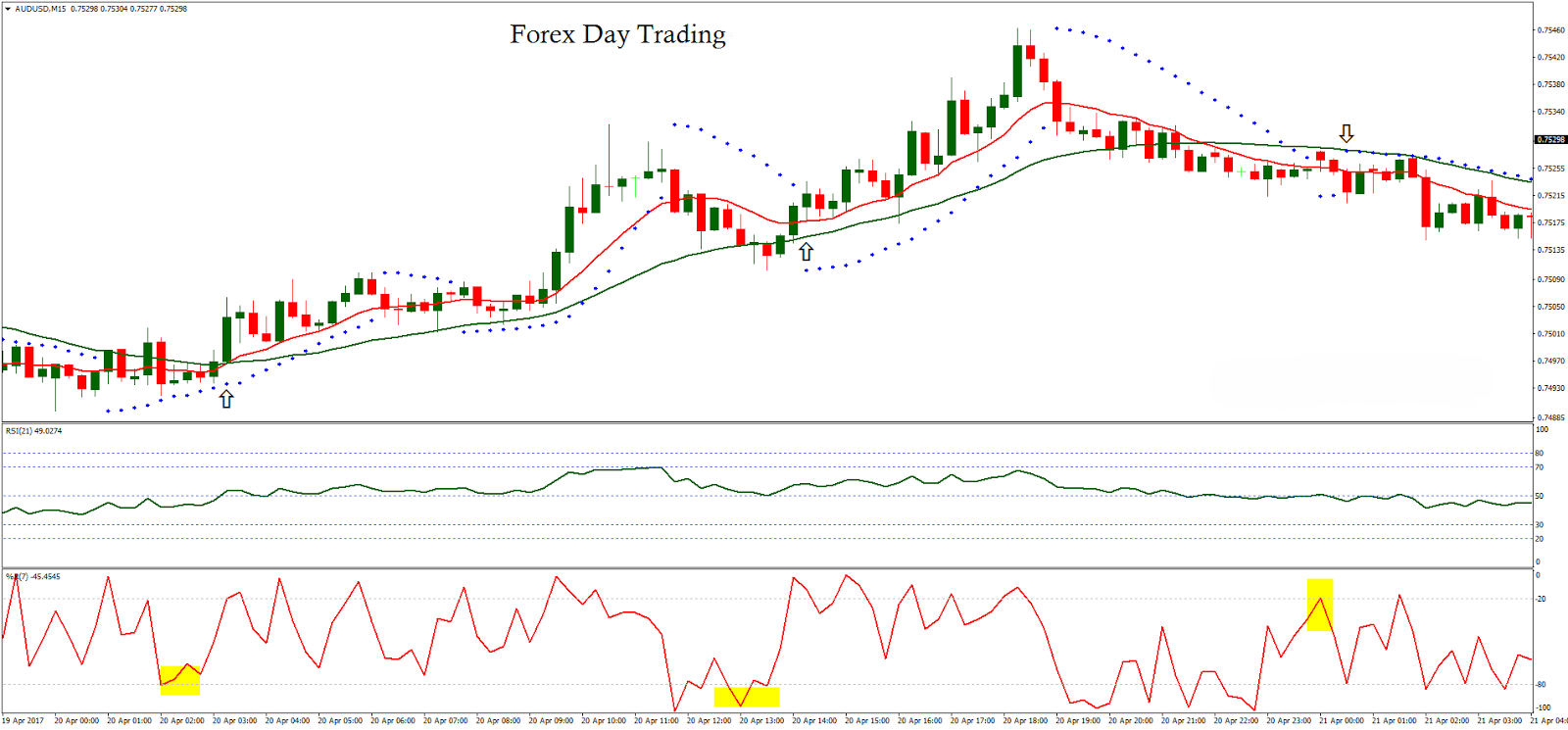
Day traders gravitate toward momentum indicators, volume analysis, and pattern recognition on short timeframes. The relative strength index, moving average crossovers, and Bollinger Bands all appear frequently on intraday charts. But the real edge often comes from understanding session behaviour — knowing that EUR/USD typically sees its sharpest moves in the first hour after the London open, or that liquidity thins noticeably heading into the New York close.
Swing traders work with higher-timeframe structure. Support and resistance zones drawn from the daily chart carry more weight than intraday noise. Fibonacci retracements, trend channels, and moving averages over longer periods — the 50-day and 200-day in particular — form the backbone of most swing setups. Fundamental context matters more, too. A swing trader holding EUR/USD for five days through a scheduled ECB meeting is taking a fundamentally different kind of analytical risk than a day trader who is flat before the announcement.
Neither approach forgives poor trade management. But swing trading tends to surface that weakness more slowly, which can make it harder to diagnose.
Costs, spreads, and trade frequency
Transaction costs look manageable per trade but accumulate quickly at day trading frequencies. A day trader executing ten to twenty round trips per session on EUR/USD at a one-pip spread is paying that cost on every single entry. Over a month, those costs become a meaningful performance drag — one that a swing trader making a handful of trades per week simply doesn't face at the same scale.
Spreads widen during low-liquidity periods: the Asian session overlap, the hour before major data releases, and the period immediately following unexpected announcements. Day traders who ignore this pay elevated costs precisely when market conditions are already harder to read.
Swap rates add another layer for swing traders. Positions held overnight incur or earn interest based on the interest rate differential between the two currencies in a pair — known as the rollover or swap rate. Depending on direction and pair, this can work in a trader's favour or erode returns over a multi-day hold. OANDA and Forex.com both publish current swap rates by instrument.
Brokers benefit from volume, which is worth keeping in mind when evaluating whether frequent trading serves the trader or the broker more.
Which approach suits which trader
There is no universal answer, and articles that suggest otherwise are usually oversimplifying. The honest framework involves matching trading style to actual constraints — not aspirational ones.
Day trading suits traders who can dedicate four to six hours of focused attention to active sessions, have access to fast execution platforms, and are comfortable making frequent decisions under time pressure. It rewards discipline and the ability to absorb a string of small losses without abandoning a process that is otherwise sound.
Swing trading suits traders with limited screen time, a preference for deliberate analysis over rapid execution, and the psychological tolerance to hold positions through short-term adverse moves. It demands patience in a way day trading doesn't — and impatience is probably the most common reason swing setups get abandoned too early.
Capital considerations matter too. Undercapitalised day traders face margin pressure quickly. Swing traders with small accounts may find that properly sized positions — wide enough stops to survive normal volatility — result in very small absolute returns per trade.
Neither style is a shortcut. Both require edge, consistency, and a risk framework that survives contact with real markets.