What is lot size in forex
New traders tend to spend hours poring over charts trying to work out how to develop a trading plan or strategy that they can follow, yet the vast majority of the time are completely oblivious to the essential fundamentals of what they are buying or selling and the comparative size of the trades involved. It is generally extremely costly in the short term.
In the forex market, when a trader enters a trade, the position is sized in lots, which determines the value of the currency position that is being traded on. Understanding the lot size is critical to effectively managing risk and to realizing potential gains or losses as the trader anticipates.
The lot size, when trading currencies (forex), seems a fairly simple concept to grasp; however, it is also a point where three very important trading concepts, namely position sizing, leverage and margin, intersect. When trading forex, in order to trade successfully, you need to know what a lot is when trading forex and how different lot sizes perform in different scenarios.
The numbers matter more than most beginners expect.
What a lot actually means in forex
In the Forex market, 1 standard lot equals 100,000 units of the base currency. This is the common volume traded in the Forex market and was inherited by retail Forex from the interbank market, where volume trading is standard.
When a trader buys one standard lot of EUR/USD, he is buying 100,000 euros at the same time as he is selling 100,000 US dollars. This transaction occurs at the prevailing market rate. The standard lot size therefore determines the size of the transaction, and nothing more.
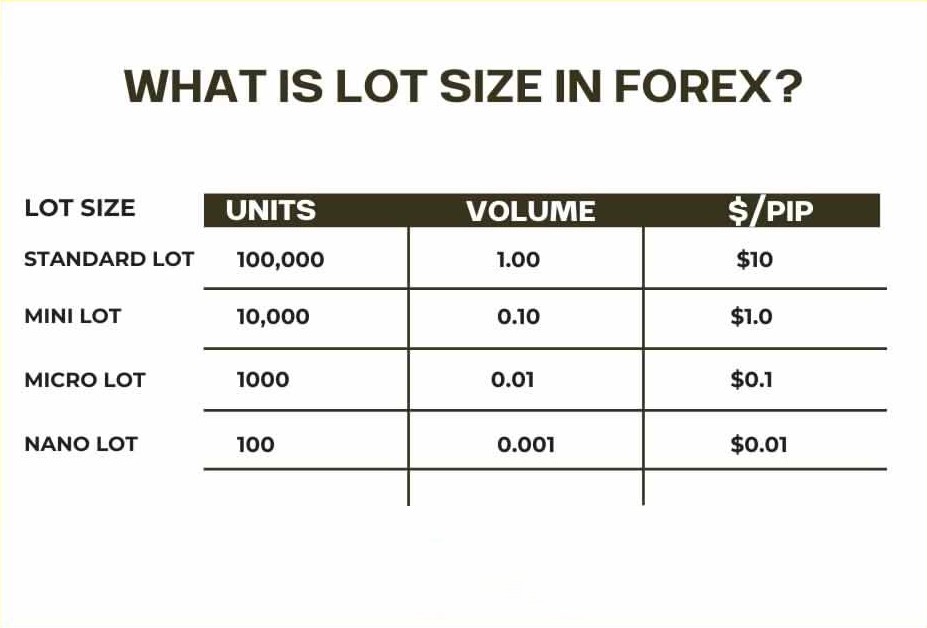
The scale of the currency pair also plays an important role. A one-pip movement on a standard lot (100,000 units) is equivalent to around $10 if USD is quoted. On a micro lot (1,000 units), this would equal $0.10. The same market price, but a drastically different risk profile.
This is why the lot size input field exists (i.e. why lot size isn't just a meaningless statistic floating about), because the lot size decides how market movement will be translated into real cash amounts that show up as profits or losses in your trading account.
The four types of lot sizes
While many traders will be working with large amounts of capital, not all will have a six figure trading account. As traders and brokers alike have got used to referring to a 100,000 unit trade size, the lot has got a new set of smaller cousins.
A mini lot is equal to 10,000 units of your currency pair, which means that it is 1/10th the size of a standard lot. Micro lots are smaller at 1,000 units of currency, and for some brokers, nano lots are available at just 100 units of currency per trade. Each decrease by a factor of 10 decreases both your potential return and your potential loss on any given trade.
A trader evaluating a strategy on the EUR/USD pair with very limited trading capital would find that at regular lot sizes, even a small backtest could potentially consume too much capital to be viable. By scaling down to micro lots, the cost of even a long test period is reduced to transactions valued in cents rather than dollars. The learning still happens, and the account remains intact to confirm it.
Not all brokers offer all types of lots. In particular, nano lots may not be offered by all brokers, so it is important to check ahead of time.
How lot size affects your pip value
For those new to trading, it is often stated that a 'pip' is the smallest possible movement in price for any given currency pair. Typically this is cited as the fourth figure on exchange rate displays (on EUR/USD for example, the space between 1.0850 and 1.0851 is therefore one pip). Simple enough. However, for those actually trading real money, it is crucial to recognise that the true value of that pip is wholly dependent on the size of their positions.
On a standard lot, one pip in a USD-quoted pair equals approximately $10. On a mini lot, it is $1. On a micro lot, it is $0.10. The math scales linearly, which makes it predictable — but traders still routinely miscalculate because they overlook the currency pair they are trading.
While most pair traded values are expressed in USD, not all pairs are USD denominated. The value of EUR/GBP for example is actually denominated in GBP, and will change as the exchange rate is used to convert it into the account base currency. This can often add an extra dimension to perceived risk if not noted.
Most online trading platforms automatically calculate the value of a pip for each currency pair but it's good to know the underlying formula so you can cross check their answer.
How lot size relates to leverage and margin
With leverage, retail traders can trade in larger volume than they have capital for without using their own money. Therefore, even with limited capital sitting in a traders' account, they can utilize the magnified gearing offered by brokers to trade in much larger volume than they have — requiring as little as $1,000 for a trader to open a standard lot of 100,000 units with 100:1 leverage, with the entire volume still under their control.
That arrangement works in both directions.
When trading the EUR/USD currency pair on a standard lot of 100,000 euros the movement of 50 pips in price can have a value of around $500 to your trading account margin – either positive or negative depending on the direction of your trade. This high level of leverage on currency broker accounts means that small trades can have a big impact on your profit and loss, and thus your trading account margin. The lot size on forex pairs will determine the value of 1 pip trade movement and how your margin can be safely sat and built up over time, or rapidly and worryingly eroded.
One of the most problematic aspects of under-capitalised accounts is their inability to process large lot sizes. It is all too easy to over trade an under-capitalised account, having little room for error between the high peak position values and the point at which a margin call will be triggered. Even a brief slide in the markets of a handful of per cent can be enough to trigger a margin call with your broker forced to rapidly close out positions in order to meet the demand for funds. This is not a risk issue; it is a mechanical process that cannot be eliminated.
Leverage and Margin are related topics, and actually all are the same, expressed in different ways: Lot size.
Choosing the right lot size for your account
There is no 'right' number for Position Size, but there is a common process used by professional traders to determine the correct size of a trade. The process typically begins with a traders' account size rather than an analysis of the market.
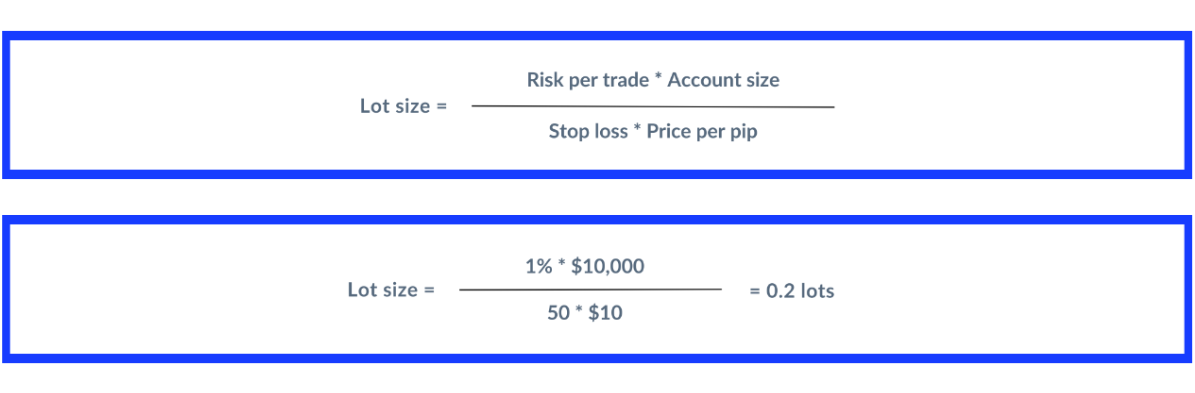
For risk management, the guideline is to keep the risk on any given trade around 1% or 2% of the total account equity. So if the account has $5,000 in it, this would mean risking $50 or $100 per trade. That dollar risk then needs to be converted into a pip distance to set the stop loss, which depends on the currency pair being traded.
Using a stop distance of 20 pips as an example — $50 divided by 20 gives a maximum pip value of $2.50, which points to somewhere between a mini and micro lot depending on the currency pair.
Risk management is not a concept reserved for cautious or inexperienced traders. It is something every participant should understand from the outset. Traders who learn this lesson during a losing streak rather than before one typically do so because they failed to run a simple calculation and consequently sized their positions incorrectly.
Conclusion
Lot size is a very under-rated aspect of trading. Traders may be working hard for months on end on their entry signals, on their indicators, on their back testing strategies, and then in a matter of seconds their position sizing is decided by their gut.
Trading mechanics are fixed. As lot size increases, so do the pip values attached to every movement, and so do the potential gains and losses on every trade. Strategies and indicators can perform well or poorly, markets can move in line with or against an individual's perception of market movement, and a trader's conviction can be shaken or solidified. However, the numbers are clear — a large position carries proportionally larger risk and reward, because the mechanics are fixed.
Revisiting the concept of lot size is worthwhile even for advanced traders, because lot size directly affects all aspects of trading — margin, pip value, risk exposure, and account longevity.
This calculation only takes about thirty seconds to complete. Maximum Risk divided by Stop Distance in Pips. It will give an answer that is either within the account's trading ability or not.
A significant proportion of traders lose money on their trading accounts over time for seemingly no reason. The key to successful trading is to understand how to correctly apply position sizing techniques.